
Capital is the key factor to expand the horizon of services and resources and sustainable growth of any business. And lack of funding to suffice the operational requirements becomes the reason for business failure. But pitching for investments and getting a deal is not a piece of cake. Company owners in Private Limited Companies find limited sources to infuse funds for the projects and operations of the company.
Currently, the market offers numerous ways to obtain finance. With each passing day, a different product is getting evolved to meet the requirements of the growing industries. There are several ways to finance a business and a range of lenders and investors to choose from when the treasury function is making financing decisions. Provisions of Section 2(68) of the Companies Act, 2013 Prohibit any invitation to the public to subscribe to any securities of the company. From the definition above, a private company cannot raise funds from the public and finds limited sources to infuse funds to run its business. In this article, we are listing sources of funding mainly for Private Limited Companies.
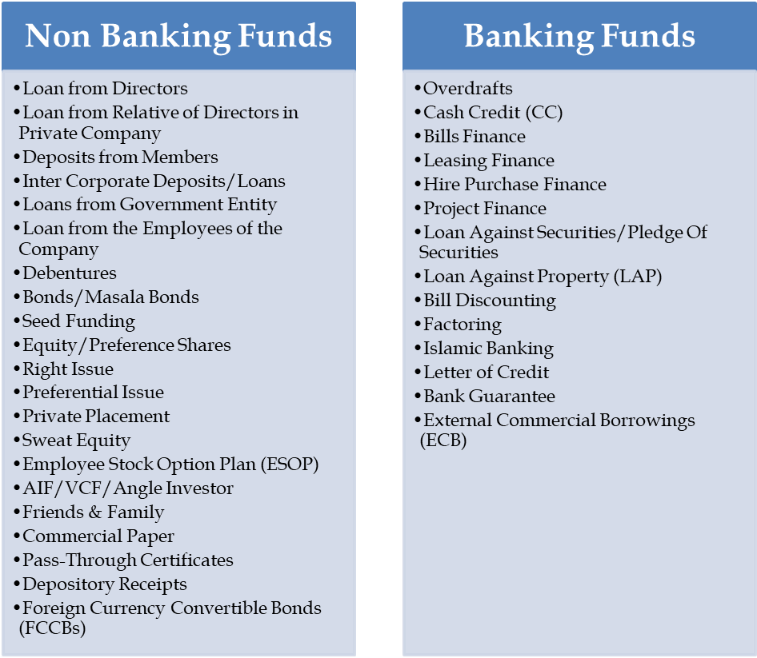
NON-BANKING FUNDS
Non-banking sources refer to the raising of finance from sources other than banks. These may include raising money through the capital market, money market, institutional investors, private equity, and others.
Considering the tightening of loopholes in the lending norms by the banking industry, it is becoming difficult for corporates to rely solely on bank loans. Thus, the non-banking sources of finance are equally important. The continuous stress over banking assets has led to the birth of various non-bank debt sources.
Borrowers can also arrange for funds from private investors, both domestic and foreign, in the form of both equity and debt. Non-banking sources are riskier as they place greater emphasis on the forced closure of businesses or taking up ownership of businesses to recover their funds. The money can be raised through various instruments and products like an issue of equity and preference shares, debentures, bonds, commercial papers, and corporate deposits.

BANKING FUNDS
As the name suggests, bank funding refers to all the sources of funds that a treasurer can access from a banking institution. This may be by way of loans, working capital funding, and fund-based and non-fund-based instruments. Banks are essentially those financial intermediaries who accept deposits for the purpose of lending. The second most important function of commercial banks is to lend money to individuals and institutions who need short-term and long-term funds.
In a Funded (Fund based) facility, there is cash outflow right from the initial stage. Examples of the funded facilities are Term Loans, Cash Credit, and Bill Purchased or bill discounting. When a term loan is disbursed, cash credit facility is sanctioned, or a bill is purchased or discounted cash flow takes place. The income earned by the banks when they extend funded facilities to the borrowers is accounted under income head interest (in case of term loans and cash credits) and discount (in case of bill discounting facility).
In a Non-funded (non-fund-based) facility, initially there is no cash outflow, later on there may or may not be cash outflow. Examples of non-fun-based facilities are Bank Guarantees (BGs) including deferred payment guarantees and Letter of Credit (LCs). When BG or LC is issued, there is no cash outflow. However later on if the guarantee is invoked by the beneficiary, the bank will have to make the payment under the guarantee at times even if there is no balance in the account of the customer. Similarly, when bills negotiated under LC are due for payment the bank may have to honor the same at times by creating a forced loan in the account of the buyer on whose behalf Letter of Credit is issued. The income earned by banks while issuing bank guarantees or LCs is accounted for under the income head "commission". Non-Fund-based credit facilities to non-borrowers of the bank.
DEBT FUNDING
Debt means money borrowed from lenders by the company and it pays the interest on that investment. Companies are required to repay the money with interest over time. Debt includes debentures, loans, borrowing, etc. Given below are the various form of Debt Funding.
BANK LOANS/BANK FINANCE
The bank is one of the most important resources for taking financial support. A Company can easily take a term loan and a working capital loan from banks or other financial institutions against the security of its assets, and moveable and immovable properties. This option is preferred when the funds from promoters are not sufficient to sponsor business operations. However, these funds are raised with the cost of fixed interest at the interval of a pre-decided long-term period.
The Banking Regulation Act of 1949 classifies bank finance into secured loans and unsecured loans. A secured loan means loans granted by the banks on the backing of some tangible security, while an Unsecured loan is one for which the banker has to rely upon the personal security of the borrower. Unsecured advances are not popular in India as they impose a huge risk of money loss in case of default by the borrower. Most of the bank advances are secured ones. Only a small portion of about 11% to 15% of the total bank advance is unsecured which usually takes the form of Overdrafts and Cash Credit Facilities.
Banks finance their customers not only in the form of loans but through other types of credit facilities also. The other types of bank finance are tailor-made to suit the needs of customers. The loans and advances wherein an immediate flow of funds is available to borrowers are called funds-based facilities. In non-fund-based facilities like issuance of letter of guarantee, letter of credit etc., banks get income in the form of fees for making available the facility and there is no immediate outflow of funds from banks.
A company must create a charge on its assets in favour of the banks from which they avail secured loan or other financing facilities by way of pledge, hypothecation, or mortgage and file requisite forms with ROC.
OVERDRAFTS
After bank loans, Overdrafts is the most common way of availing credit facilities from the bank. Overdraft means allowing the customer to draw cheques over and above the credit balance in the account. A Bank overdraft is a line of credit that overs the transaction if the Bank Account balance drops below zero. Overdraft is normally allowed to Current Account customers and in exceptional cases Savings bank account holders are also allowed to overdraw their account. A high rate of interest is charged on the daily debit balance of the overdraft account as these are clean advances i.e. banks do not have any securities to sell back if these facilities are not repaid. There are two types of overdraft accounts as prevalent in Banks i.e. (i) Temporary overdraft or clean overdraft and (ii) Secured overdraft. Temporary overdrafts are allowed purely on the personal credit worthiness of the customer concerned and it is availed by the customer to meet some urgent commitments on rare occasions. Allowing a customer to draw against his cheques sent in a clearing – known as "against clearing" also falls under this category. Secured overdraft is allowed up to a certain limit against some tangible security like bank deposits, LIC policies, National Saving Certificates shares and other similar assets. Secured overdraft is most popular with traders as lesser operating cost, simple application and document formalities are involved in this facility.
CASH CREDIT (CC)
A cash credit facility is a short-term finance to a borrower company, having a tenure of up to one year which can be renewed for a further period by the bank based on projected sales and satisfactory operation in the account during the period of finance. The cash credit facility is extended in two forms viz. Open Cash Credit and Key Cash Credit. An open Cash credit account is a running account just like a current account where the borrower is allowed to maintain a debit balance in the account up to a sanctioned limit or drawing power whichever is lower.
The Cash Credit facility is offered to borrowers normally either against pledge (Key Cash Credit) or hypothecation of stocks of raw materials, semi-finished goods, and/or finished goods and Book Debts (Receivables). In the case of Key Cash Credit, the borrower lodges the stocks in his godown, and the key of the godown will be handed over to the bank. By this process, the goods lodged in the godown are pledged to the bank and the bank will allow the customer to draw funds against the value of the goods less its safety margin. This is known as Drawing Power. The pledged goods are allowed to be removed by the borrower on remitting into his CC account the amount equivalent to the value of the goods. The bank would release further funds to the borrower within the Drawing Power (DP)/sanctioned limit on the borrower depositing (pledging) more stock in the godown. Therefore, such facility is called Key Cash Credit. Cash Credit limits are also sanctioned to a borrower against the security of term deposits, LIC policies, NSCs or Gold Jewels. This type of limit is offered mainly to traders who find it difficult to maintain a stock register and submit periodic stock statements When the security for the CC facility is jewels, life policies, NSC, Term Deposits; there is no need to submit periodic stock statements. In the case of manufacturing units, this facility is required for the purchase of raw materials, processing and converting them into finished goods. In the case of traders, the limit is allowed for the purchase of goods which they deal.
BILLS FINANCE
Bills finance is short-term and self-liquidating finance in nature. The bills can be classified as Demand Bills and Usance Bills. Demand Bill is purchased and Usance bill is discounted by the banks. The credits available to the seller against the bills drawn under the Letter of Credit either on sight draft or usance draft are called bills negotiated by the banks. The advantage of bills finance is that the seller of goods (borrower) gets immediate money from the bank for the goods sold by him irrespective of whether it is a purchase, discount or negotiation by the bank. The 'Demand Bills' can be documentary or clean. Usually, banks accept only documentary bills for purchase. However, clean bills from good parties are also purchased by banks which have a clean repayment record.
The 'Documentary Bills' may be drawn by a Seller of Goods ('Drawer') on D/P (Delivery against payment) or D/A (Delivery against Acceptance) terms. In the case of D/P terms the documents of title to goods are delivered to the buyer of the goods (drawee) against payment of the bill amount. In the case of D/A bills, the documents to the title of goods are to be delivered to the drawee (Buyer) against acceptance of bills. These types of bills are called "Usance Bills' which means bills are maturing on a future date and payment will be made on the due date. In the case of 'Usance Bills' bills become clean after it is delivered to the drawee on acceptance.
Therefore, banks take into consideration the credit worthiness not only of the borrower but also of the drawee.
LEASING FINANCE
A lease is a contract between the owner (lessor) and the user (lessee). There are various types of leases viz. operating lease, finance lease etc. In terms of the lease agreement, the lessor pays money to the supplier who in turn delivers the article to the lessee. The lessee (hirer of the article) makes a periodical payment to the lessor. At the end of the lease period, the asset is restored to the lessor. Commercial banks in India have been financing the activities of leasing companies, by providing overdraft/ Cash credit accounts/Demand loans against fully paid new machinery or equipment by hypothecation of security. The repayment should be from rentals of machinery/ equipment leased out and similar other ways. The maximum period of repayment is five years or the economic life of the equipment whichever is lower. The bank is allowed to periodic inspections of the asset. Lease contracts are only for productive purposes and not for consumer durable.
HIRE PURCHASE FINANCE
Hire-Purchase transactions are very similar to leasing transactions. Hire-purchase finance takes place predominantly in the automobile sector. Like Leasing Finance, the ownership of the vehicle continues to remain with the Leasing Company till the agreement period ends. However, at the end of the stipulated period, the hirer (lessee) has options either to return the asset to the leasing company while terminating the agreement or purchase the asset upon terms set out in the hire-purchase agreement. Since hire-purchase finance takes place predominantly in the automobile sector, banks have started direct finance to transport operators as the nature of advance is classified as priority sector lending. By and large, most banks finance vehicles under a Hypothecation arrangement instead of a Hire-Purchase. HPA is usually resorted to by NBFCs/Credit Societies/ Private Financiers (unorganized sector).
PROJECT FINANCE
Project Finance is the long-term financing of infrastructure and industrial projects based on the projected cash flows of the project. Mostly opted for in real-estate development projects and infrastructural projects, Usually, a project financing structure involves a number of equity investors, known as 'sponsors', a 'syndicate' of banks or other lending institutions that provide loans for the operationalization of the project. They are the most common loans that are secured by the project assets and paid entirely from project cash flow, rather than from the general assets or creditworthiness of the project sponsors. The financing is typically secured by all of the project assets, including the revenue-producing contracts. Project lenders are given a lien on all of these assets and are able to assume control of a project if the project company has difficulties complying with the loan terms.
Generally, a special purpose entity is created for each project, thereby shielding other assets owned by a project sponsor from the detrimental effects of a project failure. As a special purpose entity, the project company has no assets other than the project. Capital contribution commitments by the owners of the project company are sometimes necessary to ensure that the project is financially sound or to assure the lenders of the sponsors' commitment. Project finance is often more complicated than alternative financing methods. Traditionally, project financing has been most used in the infrastructure industry.
LOAN AGAINST SECURITIES/PLEDGE OF SECURITIES
Banks and financial institutions come up with innovative ways to fulfill the monetary requirements of every individual as per their credit worthiness and paying capacity. One step in this direction has been Loan against Securities, popularly referred to as LAS. Under "Loan against Securities", the loan is advanced to a customer against a pledge of securities or simply put loan against the insurance policy, mutual funds, NSC, and other securities. The list of approved securities against which LAS can be advanced varies from bank to bank, but primarily the following are considered to be approved securities against which LAS could be given:
- Non-Convertible Debentures
- Mutual Fund Units
- Bonds/NABARD Bonds
- Dematerialised Shares
- National Saving Certificates/Kissan Vikas Patra (Accepted only in Demat form)
- Insurance Policies
By pledging the securities held by the borrower, a loan against Securities is provided by a bank or a financial institution as an overdraft facility. The value of the overdraft limit that is advanced is determined based on the securities that are pledged. The rate of interest is calculated only on the amount withdrawn and only for the period of utilization.
The advantageous part of pledging your securities is that the borrower is able to get steady cash easily at the time of need and secondly the borrower need not be devoid of the benefits as a shareholder. This means that the borrower enjoys the right of receiving dividends and bonuses along with gaining from the price movements in the shares. This facility is ideal to meet short-term financial needs and the interest rates are lesser than that in a personal loan.
LOAN AGAINST PROPERTY (LAP)
Similar to loans against securities, this is a loan, banks grant against property owned by the prospective borrower. Banks take the property as security and based on the valuation of the property, they extend a loan, net of the margin fixed by them.
The types of Property against which LAP can be availed can range from owned residential properties g, self-occupied property, owned and rented property, owned land, owned commercial property, and owned but rented out commercial property. The proceeds from these are used by borrowers for personal, business and consumption purposes. After due appraisal Banks sanction generally anywhere between 50% to 65% of the value of the borrower's property. Banks offer a repayment period of 10 to 15 years at competitive interest rates. For sanctioning loans against properties banks insist on creating a mortgage in their favour.
BILL DISCOUNTING
Commercial bills are basically negotiable instruments accepted by buyers for goods or services obtained by them on credit. Such bills being bills of exchange can be kept upto the due maturity date and encashed by the seller or may be endorsed to a third party in payment of dues owing to the latter.
The most common practice is that the seller who gets the accepted bills of exchange discounts it with the Bank or financial institution or a bill discounting house and collects the money (less the interest charged for the discounting).
The biggest advantage of this facility to the seller is to get the cash released fast on the trade bill drawn which would otherwise be locked in the invoices and hence a better way to get an unsecured business loan. The volume of bills both inland and foreign, which are discounted accounted, forms a substantial part of the total scheduled commercial bank credit. Over the years this is coming down. The Reserve Bank has been attempting to develop a market for commercial bills. The bill market scheme was introduced in 1942 and a new scheme called Bill Rediscount Scheme with several new features was introduced In November 1970. Under the latter scheme the RBI rediscounts bills at the bank rates or at rates specified by it at its discretion. Since the rediscounting facility has been made restrictive, it is generally available on a discretionary basis.
The difficulties which stand in the way of bill market development are the incidence of stamp duty, shortage of stamp paper, the reluctance of buyers to accept bills, the predominance of cash credit system of lending, and the administrative work involved in handling documents of title to goods. To be freely negotiable and marketable, the bills should be first-class bills i.e. those accepted by companies having a good reputation. Alternatively, the bills accepted by companies should be co-accepted by banks as a kind of guarantee. In the absence of these criteria, the bill market has not developed in India as the volume of first-class bills is very small.
FACTORING
Factoring is a financial transaction where an entity sells its receivables to a third party called a 'factor', at discounted prices. Factoring is a financial option for the management of receivables. In a simple definition, it is the conversion of credit sales into cash. In factoring, a financial institution (factor) buys the accounts receivable of a company (Client) and pays up to 80% (rarely up to 90%) of the amount immediately on the formation of the agreement.
The factoring company pays the remaining amount (Balance 20%-finance cost-operating cost) to the client when the customer pays the debt. Collection of debt from the customer is done either by the factor or the client depending upon the type of factoring. The account receivable in factoring can either be for a product or service.
ISLAMIC BANKING
Islamic Banking or Sharia-Compliant Finance is a banking or financing activity that complies with Sharia (Islamic law) and its practical application through the development of Islamic economics. Some of the modes of Islamic banking/finance include Mudarabah (Profit sharing and loss bearing), Wadiah (safekeeping), Musharaka (joint venture), Murabahah (cost plus), and Ijara (leasing).
Sharia prohibits riba, or usury, defined as interest paid on all loans of money (although some Muslims dispute whether there is a consensus that interest is equivalent to riba). Investment in businesses that provide goods or services considered contrary to Islamic principles (e.g. pork or alcohol) is also haraam ("sinful and prohibited").
These prohibitions have been applied historically in varying degrees in Muslim countries/communities to prevent un-Islamic practices.
Islamic Banks work on the principles of interest-free banking. Islamic Banking, therefore, acts as an agent by collecting the money on behalf of its customers, investing them in Shariat compliant projects, and sharing the profits or losses with them.
There are various products in Islamic Banking that cover the needs and requirements of the consumers. Some of them are Mudarbah (profit sharing – one party provides finances, the other provides expertise), Musharaka (joint venture – both parties share everything equally), Murabaha (cost plus profit), Ijara (letting on lease), Istisna amongst others.
However, the Indian banking laws will have to be amended so as to incorporate the provisions relating to Islamic banking. For example, the Banking Regulation Act requires payment of interest which is against the principles of Islamic Banking. The Act also specifies "banking" to mean accepting deposits of money from the public for lending or investment, thus excluding within its ambit the instruments of Islamic banking that promote profit and loss.
LETTER OF CREDIT
A letter of credit is a document from a bank that guarantees payment. It is an undertaking/ commitment by the bank, advising/informing the beneficiary that the documents under a letter of credit would be honoured, if the beneficiary (exporter) submits all the required documents as per the terms and conditions of the letter of credit. A Letter of Credit is issued by a bank at the request of its customer (importer/buyer) in favour of the beneficiary (exporter/seller).
There are various types of Letter of Credit:
- Sight Credit
- Acceptance Credit/ Time Credit
- Revocable and Irrevocable Credit
- Confirmed Credit
- Back-to-Back Letter of Credit
- Transferable Credit
- Red Clause Letter of Credit/Green Clause Letter of Credit
- Standby Letter of Credit
- Revolving Credit
BANK GUARANTEE
Bank guarantees are part of non-fund-based credit facilities provided by the bank to the customers. Bank issue a bank guarantee on behalf of its client as a commitment to a third party assuring her/ him to honour the claim against the guarantee in the event of the non-performance by the bank's customer. A Bank Guarantee is a legal contract that can be imposed by law. The banker as guarantor assures the third party (beneficiary) to pay him a certain sum of money on behalf of his customer, in case the customer fails to fulfill his commitment to the beneficiary.
Banks issue different types of guarantees such as:
- Financial Guarantee
- Performance Guarantee
- Deferred Payment Guarantee
UNSECURED LOAN FROM THE DIRECTOR AND HIS RELATIVES
A company can accept unsecured loans from a director and their relatives with or without interest. For a private company, there is no limit on the amount that can be borrowed by a company from its directors or their relatives. However, at the time of giving the loan to the company, the director is required to submit a declaration to the company that the amount of loan given by him is from his own funds and is not being given out from the funds borrowed by him by way of loan or deposit from others. The company is required to mention in its Board's report the amount of unsecured loan taken from a director and his relatives.
The Promoters of a company can also provide an unsecured loan to the company if it fulfills three conditions:
- If the loan is brought in due to the condition imposed by a bank or any lending institution for promoters to bring in funds by way of a loan;
- Loan is provided either by promoters themselves or by their relatives or by both; and
- This loan shall subsist only till there is an outstanding loan from such bank or lending institution and needs to be repaid after the bank or financial institution loan has been repaid.
DEPOSIT
A Private Company may accept deposits from its members after obtaining the approval of the members in a General Meeting through Ordinary Resolution and subject to fulfilling the following conditions:
- No deposits which are repayable on demand shall be accepted or renewed.
- No deposits which are repayable on notice within a period of 6 months or more than 36 months shall be accepted or renewed.
- A company may accept deposits repayable earlier than 6 months but not earlier than 3 months, to meet its short-term fund requirements provided that such deposits don't exceed 10% of the paid-up share capital, free reserves, and securities premium account of the company.
- Amount of deposit to be accepted doesn't exceed 100% of the aggregate of paid-up share capital, free reserves, and securities premium account. Files returns of such accepted deposits with ROC in form DPT-3.
INTER-CORPORATE DEPOSIT
Inter-Corporate Deposit means any deposit or loan received by one company from another company. Inter-Corporate deposits are not considered as deposits under the Companies Act, 2013 and therefore a private limited company can accept a loan from any other company and it would not be considered as a deposit. Section 186 of the Companies Act, 2013 does not apply to any loan or guarantee given by a company to its wholly owned subsidiary or joint venture company.
LOANS FROM GOVERNMENT ENTITIES
Any amount received from the Central Government or a State Government, or local authority, or any amount received from a statutory authority constituted under an Act of parliament or a state legislature or Any amount received from foreign Governments, foreign/ international banks, multilateral financial institutions (including, but not limited to, International Finance Corporation, Asian Development Bank, Commonwealth Development Corporation and International Bank for Industrial and Financial Reconstruction), foreign government-owned development financial institutions, foreign export credit agencies, foreign collaborators, foreign body Corporates and foreign citizens, foreign authorities or persons resident outside India subject to the provisions of Foreign Exchange Management Act, 1999 and rules and regulations made there under.
LOAN FROM EMPLOYEES OF THE COMPANY
As per sub-clause (x) if clause (c) of rule 1 of the Companies (Acceptance of Deposits) Rules, 2014, the Deposit doesn't include any amount received from any employee of the Company.
Compliances to be followed by Borrower
- Being a Private Company, provisions of Section 180 (1) (a) and 180 (1) (c) i.e. Restrictions on Powers of Board relating to borrow money or to sell, lease or otherwise dispose of the whole or substantially the whole of the undertaking of the company or where the company owns more than one undertaking, of the whole or substantially the whole of any of such undertakings are exempt to the Private Companies, hence Private Companies are not required to obtain prior approval of shareholders by way of Special Resolution and Board of Directors in their meeting can take the approval for the same.
- In the case of a Secured Loan, the Company is required to execute the Security Creation Documents such as Deed of Hypothecation or Deed of Mortgage or Deed of Guarantee, etc., and need to pay stamp duty on the same.
- A company is required to file Form CHG-1 or CHG-9, within 30 days from the date of the Creation of Security.
Compliances to be followed by Lender: As per Section 186 of the Companies Act 2013, where the aggregate of the loans and investment so far made, the amount for which guarantee or security so far provided to or in all other bodies corporate along with the investment, loan, guarantee, or security proposed to be made or given by the Board, exceeding sixty percent of its paid-up share capital, free reserves, and securities premium account or one hundred percent of its free reserves and securities premium account, whichever is more, no investment or loan shall be made or guarantee shall be given or security shall be provided unless previously authorized by a special resolution passed in a general meeting. Hence if it is below the limit as specified above, then it can be done through Board Approval in their meeting.
DEBENTURES
Debenture is a document evidencing a debt or acknowledging it and any document which fulfils either of these conditions is a debenture. They can be either convertible or non-convertible into equity shares at a later point in time. The debenture is a written instrument acknowledging a debt to the Company. It contains a contract for repayment of principal after a specified period or at intervals or at the option of the company and for payment of interest at a fixed rate payable usually either half-yearly or yearly on fixed dates.
In essence, it represents a loan taken by the issuer who pays an agreed rate of interest (decided at the time of issue only) during the lifetime of the instrument and repays the principal normally, unless otherwise agreed on maturity.
Section 2(30) of the Companies Act, 2013 defines 'Debentures' as securities that include debenture stock, bonds, or any other instrument of a company that evidences a debt of the company whether constituting a charge on its assets or not.
As per Section 71 of the Companies Act, 2013, a private limited company can issue debentures with an option to convert such debentures into shares, either wholly or partly at the time of redemption. Provided that the issue of debentures with an option to convert such debentures into shares shall be approved by a special resolution passed by the shareholders in a duly convened general meeting of the company. A company can issue secured and unsecured debentures. Secured debentures may be issued by a company subject to such terms and conditions as may be prescribed. Further Company cannot issue any kind of debentures carrying any voting rights.
BONDS
A bond is a debt instrument in which an investor loans money to an entity (typically corporate or government) that borrows the funds for a defined period of time at a variable or fixed interest rate. Bonds are used by companies, municipalities, states and sovereign governments to raise money to finance a variety of projects and activities. Owners of bonds are debt holders, or creditors, of the issuer.
The bondholders are generally like a creditor where a company is obliged to pay the amount. The amount is paid on the maturity of the bond period. Generally, these bonds' duration would be for 5 to 10 years. Based on the maturity period, bonds are referred to as bills or short-term bonds and long-term bonds. Bonds have a fixed face value, which is the amount to be returned to the investor upon maturity of the bond. During this period, the investors receive a regular payment of interest, semi-annually or annually, which is calculated as a certain percentage of the face value and known as a 'coupon payment.'
MASALA BONDS
With a unique name, Masala Bonds are rupee-denominated borrowings by Indian companies in overseas markets. This is different from the other overseas borrowings in the sense that in the other borrowings, the currency is normally the dollar, euro, yen, etc. whereas Masala Bonds are Rupee denominated.
The advantage of issuing masala bonds is that the company does not have to worry about the depreciation in the rupee in comparison to the other bonds/ instruments that are denominated in foreign currencies. This is normally a big worry for corporates while raising money in overseas markets. If the rupee weakens at the time of the redemption of the bonds, the company will have to pay more rupees to repay the dollars. Many companies which had raised funds via Foreign Currency Convertible Bonds in 2007 found themselves in great difficulty as the rupee had depreciated very sharply during the global financial crisis.
In order to compensate for the risk of currency depreciation, the buyer of the Masala Bond will get a higher coupon rate and therefore earns a higher yield.
Many public and private companies are in the fray to issue masala bonds as the companies can have access to more funds at a marginally higher cost of financing.
The masala bonds were reckoned under both corporate debt and external commercial borrowings for Foreign Portfolio investment. The Reserve Bank of India recently amended the Regulations and currently treats Masala Bonds under the ECB category only, where a borrower just needs to seek the RBI's approval to sell those securities.
SEED FUNDING
Seed funding, taken from the word "seed" is the capital needed to start/expand your business. It often comes from the company founders' personal assets, from friends and family or other investors. The amount of money is usually relatively small because the business is still in the idea or conceptual stage.
This type of funding is often obtained in exchange for an equity stake in the enterprise, although with less formal contractual overhead than standard equity financing.
Lenders often view seed capital as a risky investment by the promoters of a new venture, which represents a meaningful and tangible commitment on their part to making the business a success.
EQUITY SHARES
Equity shareholders are members of the company and they are the beneficial owners of the company as they invest their hard-earned funds in the company with almost no or low return. The Promoters of a company can infuse finance into the company by investing in equity shares of the company at the time of incorporation of the company and at any other time when equity shares are issued by the company either through private placement, or rights issue, or preferential allotment of shares. A private company can also issue shares on a private placement basis or preferential allotment basis to people other than promoters.
PREFERENCE SHARES
Section 43 of the Companies Act, 2013 defines "Preference shares" as that part of the issued share capital of a company that carries or would carry preferential rights with regard to:
- Payment of dividend either at a fixed amount or an amount calculated at a fixed rate, and
- Repayment of share capital in the event of winding up of the company.
Preference shares can be issued at a pre-determined dividend rate. Dividends paid on preference shares can be cumulative (interest is accumulated and paid on a specific date) or non-cumulative (interest is not accumulated and paid yearly). Preference shares can be convertible i.e. it can be converted to equity shares on a specified date or non-convertible. A preference share is a good tool to arrange finance for a company without parting with ownership rights of the company, unlike equity shares.
RIGHT ISSUE
One of the methods to infuse capital in the Company is by way of 'Right Issue'. 'Right Issue' can also be defined as the pre-emptive right that an existing Equity Shareholder has in the Company in preference to an outsider. The allotment of shares by way of the right issue is governed by section 62(1)(a) of the Companies Act, 2013.
In the case of a rights issue, shares are offered by the company to the people who on the date of the offer are existing equity shareholders of the company, and the shares offered are in proportion to their existing shareholding in the company.
Shares include Equity Shares as well as Preference Shares, and since the provision says Shares are issued to existing equity shareholders of the company, the Private companies can issue any type of shares by way of Right Issue to the existing Equity Shareholders of the Company, however, Company cannot issue any other Securities other than shares by way of a Right Issue. Private Companies Issuing Preference Shares shall also need to comply with Section 55 of the Companies Act, 2013 and rule 9 of The Companies (Share Capital and Debentures) Rules, 2014.
As per Section 62(1) of the Companies Act, 2013 any letter of offer for a rights issue should provide the members with the right to renounce the shares offered to him in favour of any other person and such other person does not necessarily have to be an existing shareholder of the company. In case, the existing shareholders are not willing to subscribe to the rights, he/she can transfer or sell such rights to outsiders. However, in the case of Renunciation, provisions of Income Tax relating to Capital Gains will become applicable on a case-to-case basis.
As per the provisions of Section 62(1)(a), in the case of Right Issue of Shares, Private Company may after the expiry of the time specified in the notice aforesaid, or on receipt of earlier intimation from the person to whom such notice is given that he declines to accept the shares offered, the Board of Directors may dispose of them in such manner which is not dis-advantageous to the shareholders and the company.
This means if existing shareholders decline or they do not subscribe to the shares offered to them, then the Board of Directors may dispose of them in such a manner that is not dis-advantageous to the shareholders and the company.
PREFERENTIAL ALLOTMENT
Preferential allotment of shares is made as per provisions of Section 62 (1)(c) and Rule 13 of Companies (Share Capital and Debentures) Rules 2014. "Preferential offer" means an issue of shares or other securities by a company to a select person or group of persons on a preferential basis. The preferential issue does not include shares issued by way of private placement, rights issue, bonus issue, employee stock option or the like.
The expression, "shares or other securities" means equity shares, fully convertible debentures, partly convertible debentures, or any other securities, which would be convertible into or exchanged with equity shares at a later date.
The preferential allotment can be made for cash or consideration other than cash. A company can issue shares on a preferential basis to its promoters, other companies, venture capitalists, angel investors, etc. for raising funds as required by it.
PRIVATE PLACEMENT
As per Section 42 of the Companies Act 2013, "Private Placement" means any offer of securities or invitation to subscribe or issue of securities to a select group of persons who have been identified by the Board of the company (other than by public offer) through private placement offer letter and which satisfies the conditions as stipulated in this section.
In Private Placement, any security including Equity shares, Preference shares, Debentures, Bonds, or other marketable securities, whether convertible or not, can be issued.
For private placement of securities, the company should issue a private placement offer letter to select persons identified by the Board of the company, and those persons should submit the application form to the company and pay the application money either by cheque or demand draft or any other mode except through cash. The company is required to file necessary forms in this regard and also to keep the application money in a separate bank account which should not be utilized unless an allotment of shares is made, and the return of allotment is filed for the same.
SWEAT EQUITY SHARES
'Sweat equity shares' are such equity shares, which are issued by a company to its directors or employees at a discount or for consideration, other than cash, for providing their know-how or making available rights in intellectual property rights or value additions, by whatever name called.
Sweat equity shares refers to equity shares given to the company's employees on favourable terms, in recognition of their work.
Sweat equity shares refers to equity shares given to the company's employees on favourable terms, in recognition of their work. Sweat equity shares is one of the modes of making share-based payments to employees of the company. The issue of sweat equity shares allows the company to retain employees by rewarding them for their services. Sweat equity shares reward the beneficiaries by giving them incentives in lieu of their contribution towards the development of the company.
The Company issue shares at a discount or for consideration other than cash to selected employees and directors as per norms approved by the Board of Directors of the Company. This is based on the know how provided or intellectual property rights created and given for value additions made by such directors and employees to the company.
Private companies having scarce funds or startups can issue sweat equity shares, as per Section 54 of the Companies Act, 2013, to its directors or employees for consideration other than cash in lieu of the services or the know-how given by such employees or directors to the company. The issue of sweat equity shares is a win-win situation both for the company and the Employees as the company would not have to part with major funds for availing value-added services or know-how and the employees would be inclined to work austerely for a company in which they have a stake.
EMPLOYEE STOCK OPTIONAL PLAN ("ESOP")
An employee stock option/ownership plan (ESOP) is a type of employee benefit plan which is intended to encourage employees to acquire stocks or ownership in the company.
Under these plans, the employer gives certain stocks of the company to the employee for negligible or lesser costs which remain in the ESOP trust fund, until the options vest and the employee exercises them, or the employee leaves/retires from the company or institution.
ESOPs are an incentive tool gaining popularity in India, especially in companies that cannot offer high-grade salaries to their employees and simultaneously want the employees to work with a sense of ownership in the Company. ESOPs help motivate the employees and encourage them to contribute to the growth and profitability of the Company.
ESOPs can benefit the company along with the employees as it has been shown to improve the organizational performance of a company to a great extent. Increased organizational performance typically leads to a higher share price and therefore a higher balance in employee ESOP accounts. ESOP is in the form of Equity shares which implies that if an employee exercises his/her option, he/she will actually own part of the company and if the company does well the value of those shares will also rise.
ANGLE INVESTOR
Angel investors are high-net-worth persons, who lend funds in exchange for the ownership stake in any company. Because they get an equity position in the company, angel investors provide substantial amounts of capital when they find the company where they wish to invest. Angel investors are mainly founder professionals in private equity; it any business wants funding, it must pitch its need for financing with current financial statements, a complete business plan, and a viable exit strategy.
VENTURE CAPITAL
Venture capitalists invest in business during the startup stage. If they believe the business will be profitable, the venture capitalist invests money in exchange for equity in the form of company shares. And, when the company makes money, the venture capitalist also earns profits.
Venture Capital is one of the innovative financing resources for a company in which the promoter has to give up some level of ownership and control of the business in exchange for capital for a limited period, say, 3-5 years.
Venture Capital is generally equity investments made by venture capital funds, at an early stage in privately held companies, having the potential to provide a high rate of return on their investments. It is a resource for supporting innovation, knowledge-based ideas, and technology and human capital-intensive enterprises.
Essentially, a venture capital company is a group of investors who pool investments focused within certain parameters. The participants in venture capital firms can be institutional investors like pension funds, insurance companies, foundations, corporations or individuals. Unlike banks, which seek their return through interest payments, venture firms seek for capital appreciation. Generally, venture capital firms look for a return of five to ten times the original investment.
FRIENDS AND FAMILY
Initially, personal resources are used to finance business operations in a private limited company. Once financing from personal savings dries up, owners may get financial support from their friends and family members. Here the plus point is that friends and family who invest in the business do not take an active role in operations.
COMMERCIAL PAPER
Commercial paper, or CP, is a short-term debt instrument issued by companies to raise funds generally for a time period of up to one year. It is an unsecured money market instrument issued in the form of a promissory note and was introduced in India in 1990. Corporates that enjoy a high rating can diversify their sources of short-term borrowings using CPs.
The Companies Act does not specifically provide for CPs. Further, no definition for CPs exists under Company law. Thus, they would be treated like any other borrowings and would consequently trigger Section 179 and 180 for borrowing through CPs.
Also, since CPs are not securities, provisions relating to the Private Placement of securities (Section 42 of Companies Act, 2013) would not apply to the issue of CPs.
PASS THROUGH CERTIFICATE
A Pass-Through Certificate is a financial instrument that permits the holder of the certificate or investor to earn a fixed income from the proceeds of the certificate. It is issued to the investor against the asset or mortgage-backed securities that have been pooled together in a single securitized loan package, which the issuer holds.
Financial institutions like banks, asset management companies, and insurance companies typically issue such certificates. Such institutions provide a large number of mortgages to their customers. These mortgages are pooled together in a large investment and sold to other financial institutions like Asset Management Companies or Insurance companies.
AMCs or Insurance Companies then create a debt instrument and sell it to the investor as a Pass-Through Certificate that delivers fixed income to the investor.
To understand Pass-Through Certificates better, you need to understand the concept of Securitization.
Banks provide a wide range of loans, including home loans, commercial loans, and auto loans. These loans result in income or receivables for the lending institutions.
Securitization is the process of converting these receivables or incomes into debt instruments that are then sold to individual investors. A Special Purpose Vehicle is set up to issue these debt instruments to the investors.
When an investor purchases these debt instruments, they are given a Pass-Through Certificate by the Special Purpose Vehicle.
FOREIGN FUNDING
The Government of India has taken various policy initiatives to allow Indian companies to raise funds from International Market. These policy initiatives have led to the introduction of International Instruments like
American Depository Receipts (ADR), Global Depository Receipts (GDR), Foreign Currency Convertible Bonds (FCCBs), and Foreign Currency Exchangeable Bonds (FCEBs) etc.
Indian companies are allowed to raise capital in the international market through the issue of GDR/ADR/FCCB/ FCEB and through External Commercial Borrowings.
Euro Equity: Euro equity issue represents shares denominated in dollar terms, issued by non-American and non-European companies to list their shares on American and European stock exchanges by complying the regulations of respective stock exchanges where the shares are intended to be listed. The euro equity issue can be made in different forms like American Depository Receipts and Global Depository Receipts.
Euro Debt: Debts raised from the international capital market by complying with regulations of the respective country of which the capital market is accessed is called as euro debt. Euro debt can be issued in the form of ECB/FCCB/FCEB etc.
EXTERNAL COMMERCIAL BORROWING (ECB)
ECBs are commercial loans raised by eligible resident entities from recognized non-resident entities and should conform to parameters such as minimum maturity, permitted and non-permitted end-uses, maximum all-in-cost ceiling, etc. The parameters apply in totality and not on a standalone basis.
ECB can be raised in the following two options:
- Foreign Currency denominated ECB
- INR/Rupee Denominated ECB
Forms of Foreign Currency denominated ECB are Loans including bank loans; floating/ fixed rate notes/ bonds/ debentures (other than fully and compulsorily convertible instruments); Trade credits beyond 3 years; FCCBs; FCEBs and Financial Lease.
Forms of INR/Rupee Denominated ECB are Loans including bank loans; floating/ fixed rate notes/ bonds/ debentures/ preference shares (other than fully and compulsorily convertible instruments); Trade credits beyond 3 years; and Financial Lease. Also, plain vanilla Rupee denominated bonds issued overseas (RDBs), which can be either placed privately or listed on exchanges as per host country regulations.
DEPOSITORY RECEIPTS
A Depository Receipt (DR) is a negotiable financial instrument issued by a company in a foreign jurisdiction. They represent certain securities like bonds, shares etc. DR is an important mechanism for raising funds by tapping foreign investors who otherwise may not be able to participate in the domestic market.
In India, any company, whether listed or unlisted are capable of issuing DRs. The issue of DRs is regulated by the Ministry of Finance and by the Depository Receipts Scheme, 2014. Depending upon the location in which DRs are issued, they are called American Depository Receipts ("ADR") or in general Global Depository Receipts (GDRs).
Typically, companies in India issue securities in the form of depository receipts (DR) viz American Depository Receipts (ADR), Global Depository Receipts (GDR) or Foreign Currency Convertible Bonds (FCCB). While ADR and GDR are equity instruments, FCCB is a convertible debt instrument.
FOREIGN CURRENCY CONVERTIBLE BONDS (FCCBs)
Foreign Currency Convertible Bonds (FCCBs) are optionally convertible bonds issued in a currency other than the Indian Rupees. A convertible bond is a mix between debt and equity instruments. It acts like a bond by making regular coupon and principal payments, but these bonds also give the bondholders the option to convert the bond into shares at the expiry the term of the Bond.
The FCCBs are unsecured and carry a fixed rate of interest and an option for conversion into a fixed number of equity shares of the issuer company. Interest and redemption price (if conversion option is not exercised) is payable in dollars. FCCBs shall be denominated in any freely convertible Foreign Currency. However, it must be kept in mind that FCCB issue proceeds need to conform to ECB end-use requirements. Apart from the policy of ECB, the issue of FCCB is also required to adhere to FEMA Regulations.The major drawbacks of FCCBs are that the issuing company cannot plan its capital structure as it is not assured of conversion of FCCBs. Moreover, the projections for cash outflow at the time of maturity cannot be made
Disclaimer: This article provides general information existing at the time of preparation and we take no responsibility to update it with the subsequent changes in the law. The article is intended as a news update and Affluence Advisory neither assumes nor accepts any responsibility for any loss arising to any person acting or refraining from acting as a result of any material contained in this article. It is recommended that professional advice be taken based on specific facts and circumstances. This article does not substitute the need to refer to the original pronouncement









 CAclubindia